
Delphi MTK Client Source Code for Windows
DelphiMTKClient is a professional Delphi MTK client source code project with a Windows VCL GUI, developed by the Alephgsm team for MediaTek / MTK chipset devices.
This is not positioned as a simple compiled tool for regular users. The main value of the project is the source code, protocol implementation, architecture and development base it provides.
DelphiMTKClient is now aligned with SharpMTKClient on the live protocol and service paths: BROM / Preloader, Download Agent, LEGACY, XFLASH and XML / MTK V6, firmware flashing (scatter, flash.xml and OPPO .ofp), partition management, file-system access, NV / IMEI, RPMB, hardware key reading and the same advanced patch / service workflows.
The USB protocol layer is based on Windows APIs such as kernel32. There is no UsbDk dependency. Libusb is used only for selected ControlTransfer paths where required by specific workflows.
If you are building a private MTK service product, an internal research tool, a custom flashing solution, a device maintenance system or a commercial mobile software platform, DelphiMTKClient gives you a ready Delphi foundation instead of starting MTK protocol development from zero.
The project has been tested across many MediaTek devices and brands, including Xiaomi, OPPO, Samsung, Huawei, Vivo, Infinix, Tecno, Itel, Motorola, TCL and other supported targets. Feature availability always depends on chipset, boot mode, selected DA, firmware package, security state and operation type.
Product Overview
- Product: DelphiMTKClient (Delphi 12) Source code
- Technology: Delphi / VCL / Windows Desktop
- Target chipset family: MediaTek / MTK
- Protocol families: LEGACY, XFLASH, XML / MTK V6
- Target audience: developers, software owners, R&D teams and companies
- Delivery type: source code project
- Category: Solutions and Source Code
- Current version: 2026.08.23
document:
- DelphiMTKClient Review
- Feature Matrix
- Buyer Guide
- Compile and Debug Guide
- Support Policy
- Media Kit
- Commercial License Terms
Who Is DelphiMTKClient For?
DelphiMTKClient is designed for technical users who understand source code, protocol integration and product development. It is useful for people who need to study, extend, customize or integrate MTK logic into their own software.
- Delphi developers who need MTK protocol source code
- Software owners building their own MediaTek service product
- Research teams working on MTK protocol behavior
- Companies that need a customizable MTK Windows codebase
- Developers migrating a C# / SharpMTKClient workflow to Delphi
- Teams that need private branding, private workflows or model-specific logic
This project is not intended for regular end users who only want to click a button and repair a phone. It is intended for developers who want the source code and need control over how the MTK workflow is built.
Why Source Code Matters
MTK software development is not only about having a user interface. A serious MTK client needs correct handling of device detection, handshake, DA loading, storage information, partition layout, flash protocol, XML command flow, error handling, security states and model-specific behavior.
With DelphiMTKClient, developers get a source code base that can be studied, changed and extended. You can add your own device profiles, change UI behavior, integrate private DA selection logic, add custom patch workflows, change logging, connect it to licensing systems or build a branded product on top of the existing architecture.
The protocol names, control flow and Window operations match SharpMTKClient. Delphi stays idiomatic (records, TBytes, VCL, Winapi) instead of forcing C# patterns.
Core Protocol Support
- LEGACY: classic MediaTek DA-based workflow for supported devices.
- XFLASH: modern DA flow with native partition operations and DA extension paths where available.
- XML / MTK V6: XML command workflow for supported devices and firmware packages (
flash.xml).
Protocol availability depends on chipset, boot mode, selected DA, security configuration and target operation. The source code is structured so developers can inspect and extend these paths for their own requirements.
Delphi MTK Client Source Code Features
- Auto-detect MediaTek devices by VID / PID.
- USB plug / unplug event handling without busy waiting loops.
- BROM and Preloader communication workflows.
- Device type support for LEGACY, XFLASH and XML workflows.
- Support paths for EMMC, UFS and NAND where DA and protocol allow it.
- Auto SLA / DAA handling paths where supported.
- Preloader crash / boot preparation paths where supported.
- MTKV5 and MTKV6 firmware flashing.
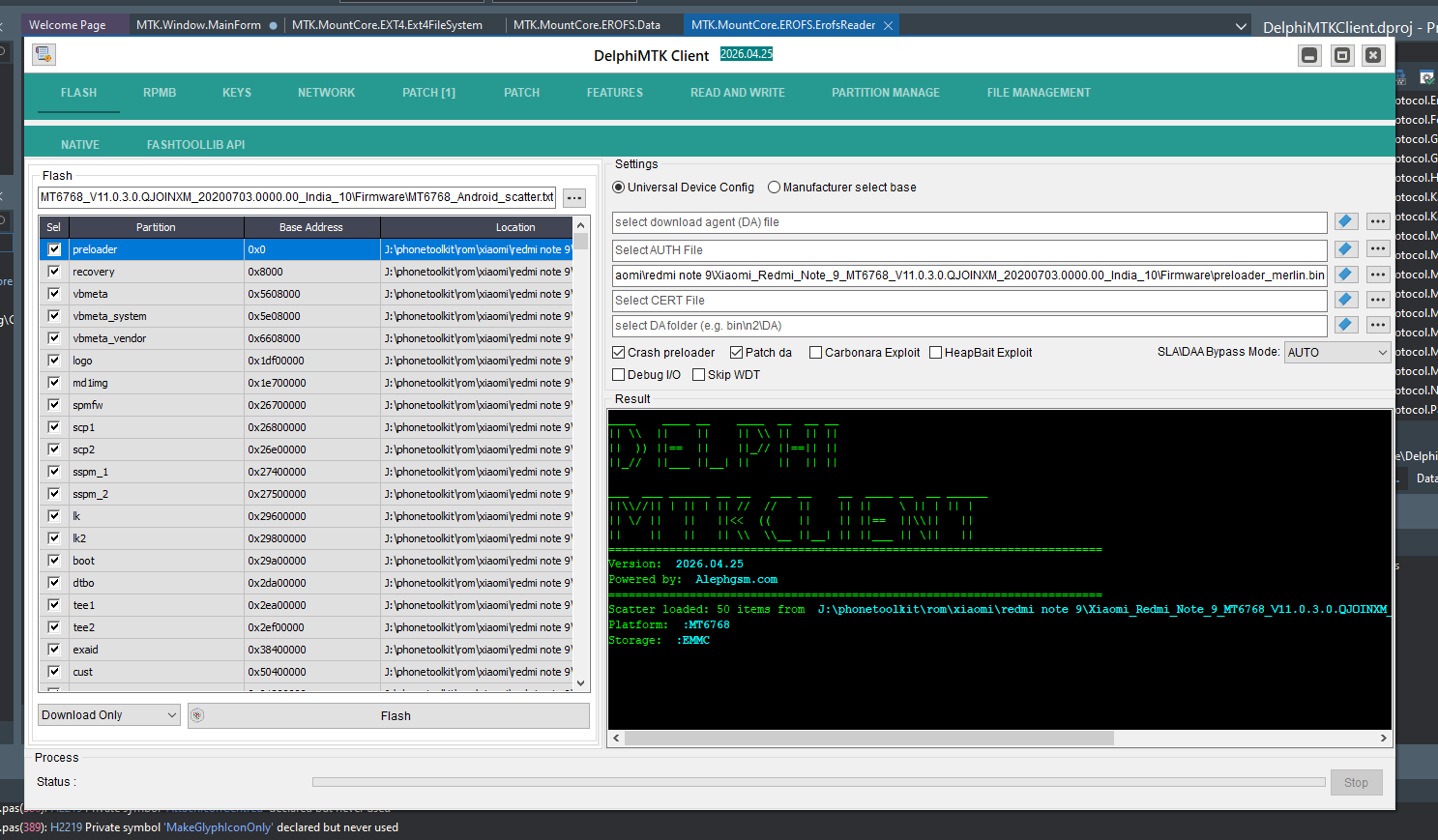
- Scatter firmware workflow (Native tab).
- SP Flash Tool API path (FashtoolLib API tab).
- OFP Flasher tab: flash OPPO
.ofppartitions directly, no full extract. - MTK V6
flash.xmlworkflow. - Native XML firmware write paths: download, firmware upgrade and download-only.
- Flash partition by name for XML and XFLASH workflows.
- Flash raw firmware.
- Raw and sparse image handling from device or file.
- Read Oxygen Forensics Detective dump paths where supported.
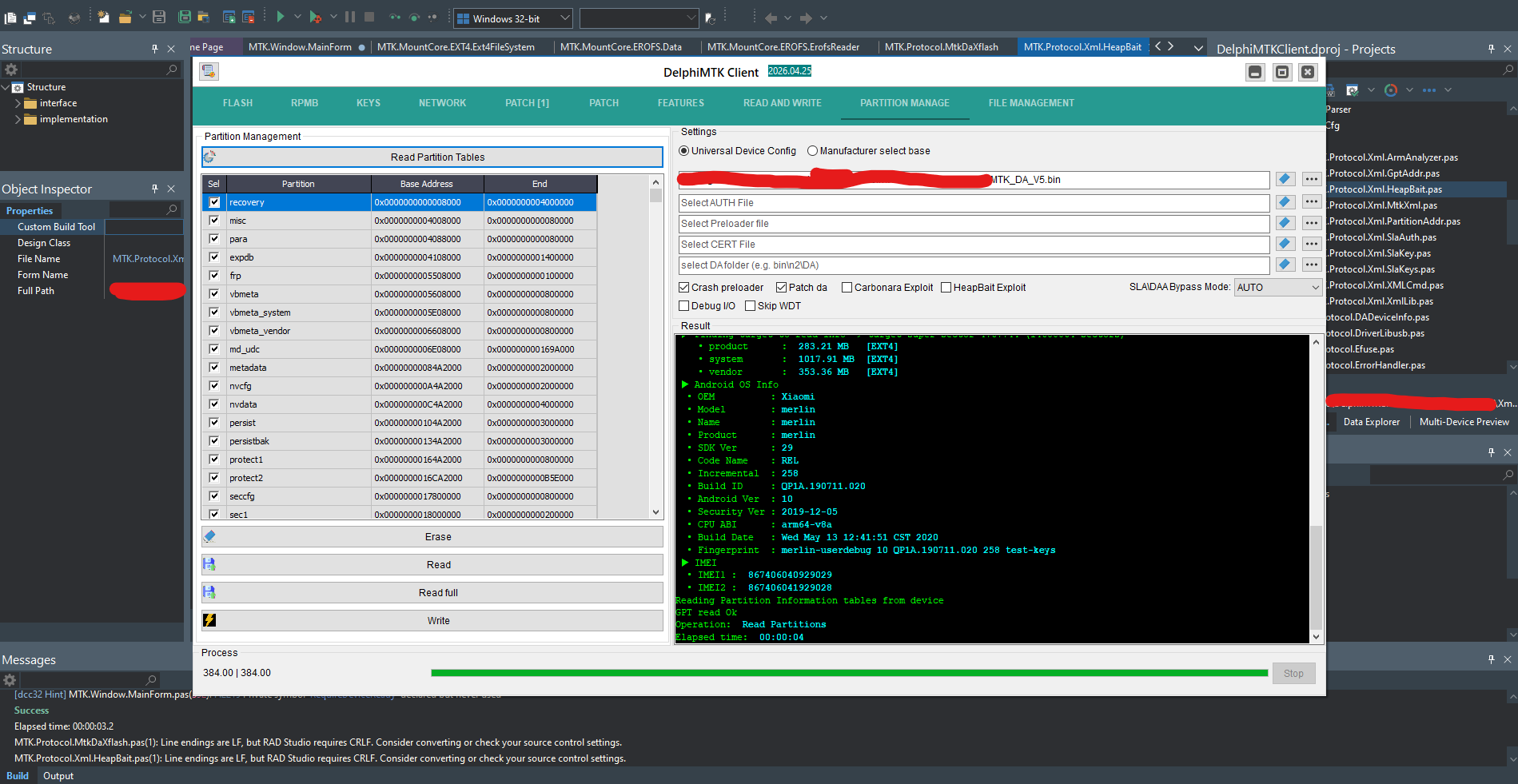
- Read GPT / partition table.
- Flash GPT.
- Rebuild GPT.
- Dump / backup partitions and write
{platform}_Android_scatter.txtnext toGPT.pit. - Read selected partitions.
- Write selected partitions.
- Erase selected partitions by name or sector.
- Read preloader.
- Flash preloader.
- Safe format workflow.
- Manual format workflow.
- FRP erase / reset workflow.
- Backup, write and erase NV partitions.
- Bootloader unlock and relock paths.
- Permanent bootloader unlock paths where supported.
- Fix read / orange state after bootloader unlock.
- RPMB read, write and erase paths.
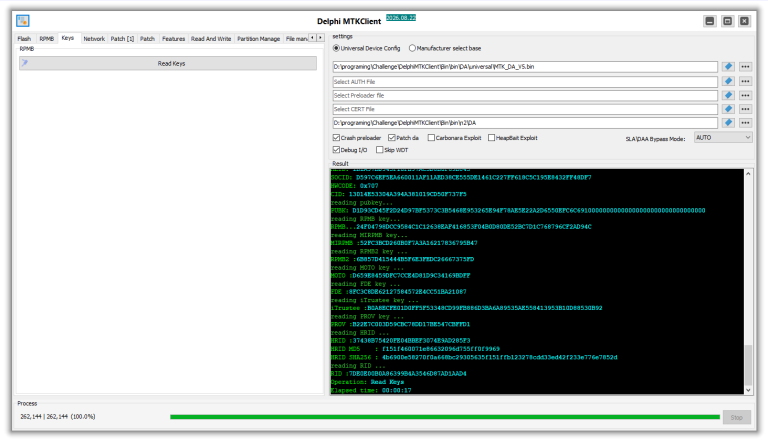
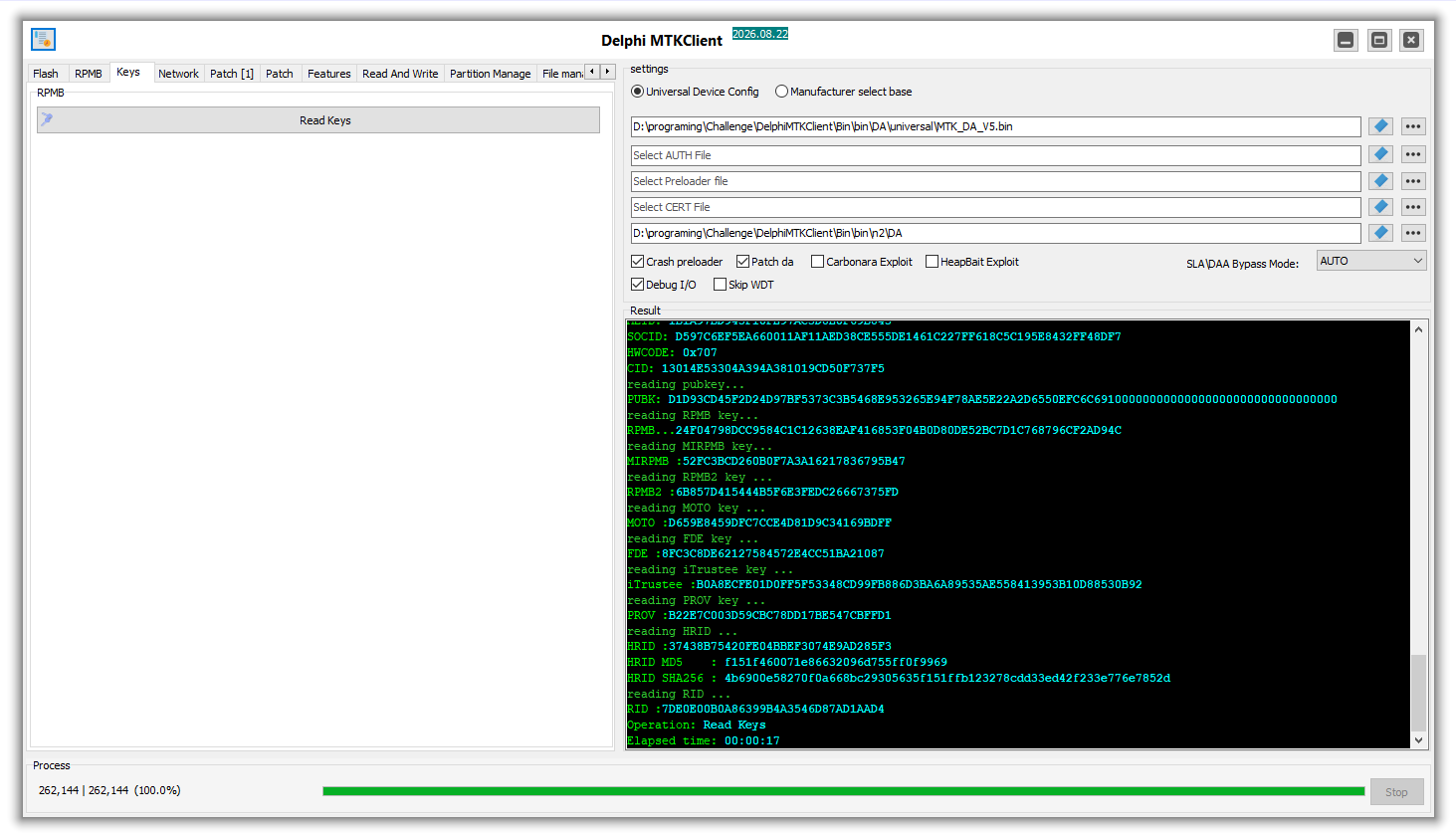
- RPMB key read paths where supported.
- Hardware key read paths (DXCC / SEJ / SSR / GCPU where the engine is present).
- DA parser and Preloader parser.
- Device information and Android OS information reading.
- Android
build.propparser from supported partitions.
File-System and Partition Explorer Features
- Partition explorer for EXT4, EROFS and F2FS readable partitions.
- Native Delphi EXT4 stream reader and writer paths (no DLL wrapper).
- Mount EXT4 partitions and list files / directories with details such as modified date, UID and GID.
- Logical partition and
super.imgmetadata handling. - Browse EXT4 items from logical partitions inside
super.img. - Extract and dump files or directories from EXT4 partitions.
- Replace files inside EXT4 partitions where supported.
- Delete files from EXT4 partitions where supported.
- Add new files to EXT4 partitions where supported.
- Rename readable partition file items where supported.
- Copy readable partition files to local storage.
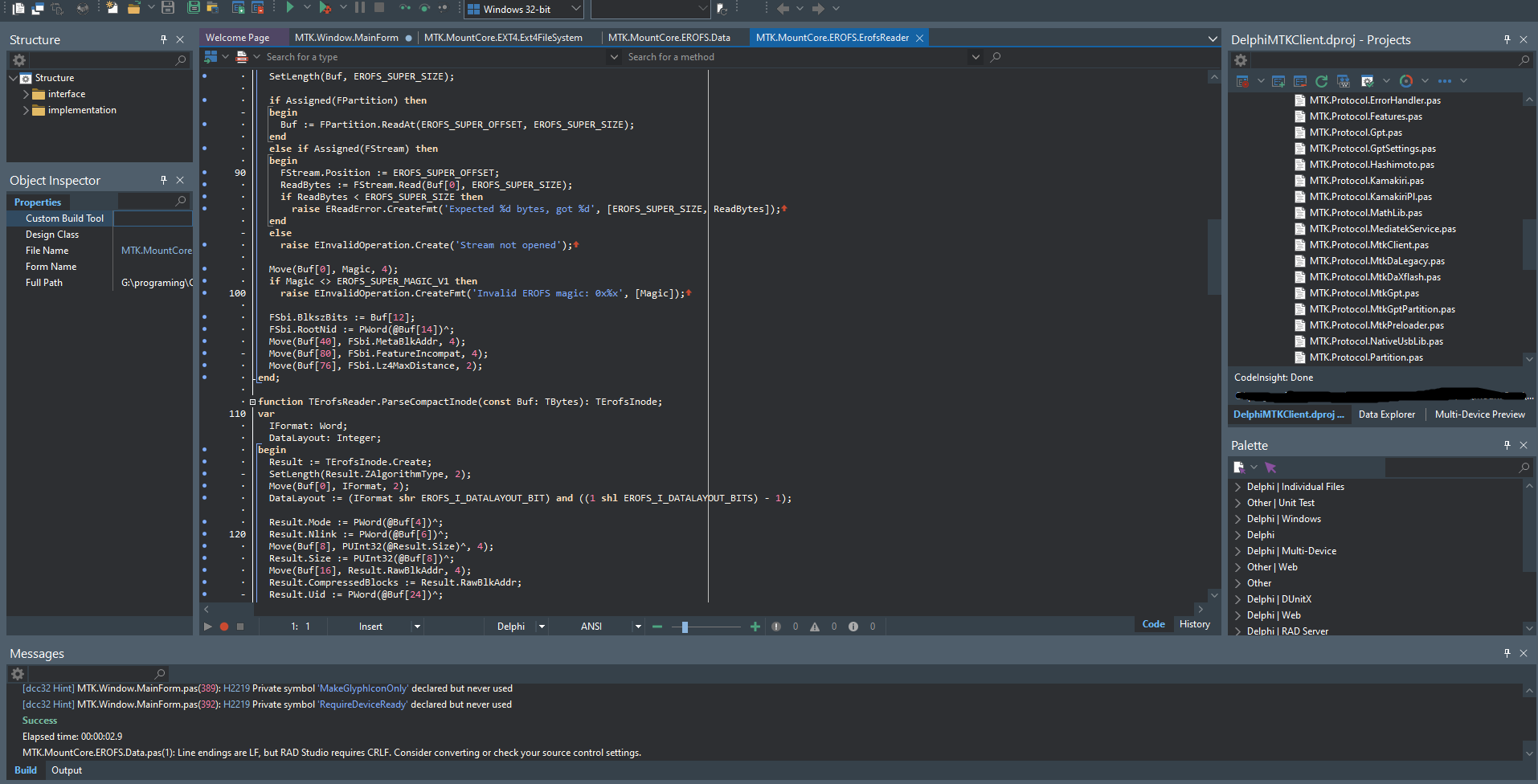
- EROFS detection and read paths.
- F2FS detection and read paths.
- Android information extraction from supported system / super partitions.
Advanced Patch and Service Features
- Patch certificate workflows.
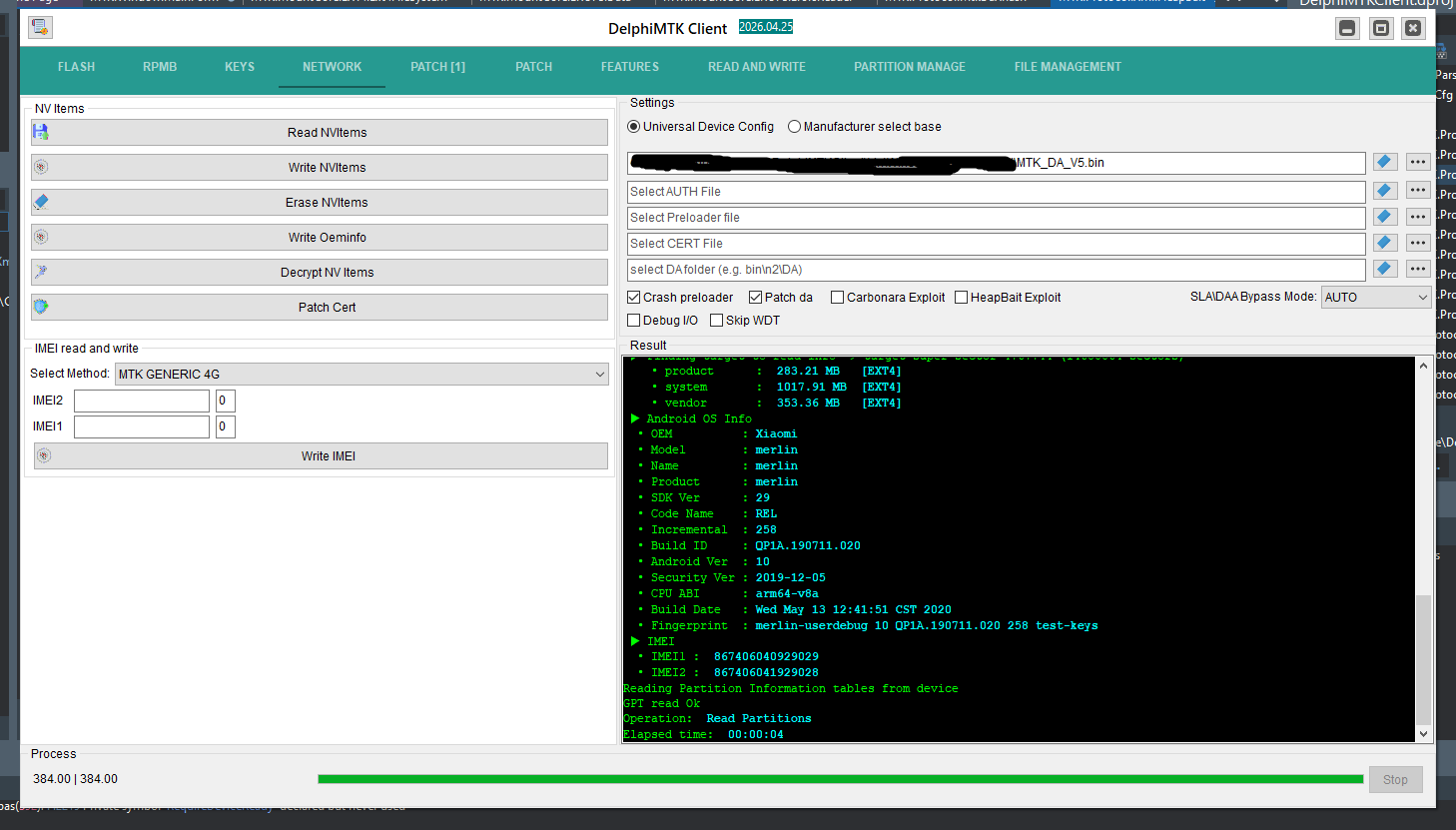
- IMEI information read from device paths such as
nvdataandld0b. - Decrypt NV items.
- IMEI repair for IMEI1 / IMEI2 in FlashMode where supported.
- IMEI repair workflow areas for selected Vivo, Xiaomi, OPPO, Infinix, Tecno and Itel targets.
- Universal and Samsung MT67xx IMEI-related paths where supported.
- Motorola Direct IMEI repair and Unlock Network on supported MTK 4G models.
- Remove Payjoy.
- Payjoy Remove through selected
oeminfopaths. - IT Admin / Network / Payjoy Unlock.
- Reset Huawei ID.
- Reset OPPO ID.
- Disable Mi Account through supported system, APK and hosts methods.
- Mi Account + Global through selected
cust/opcustpaths. - Mi Account Remove + Convert Global V2.
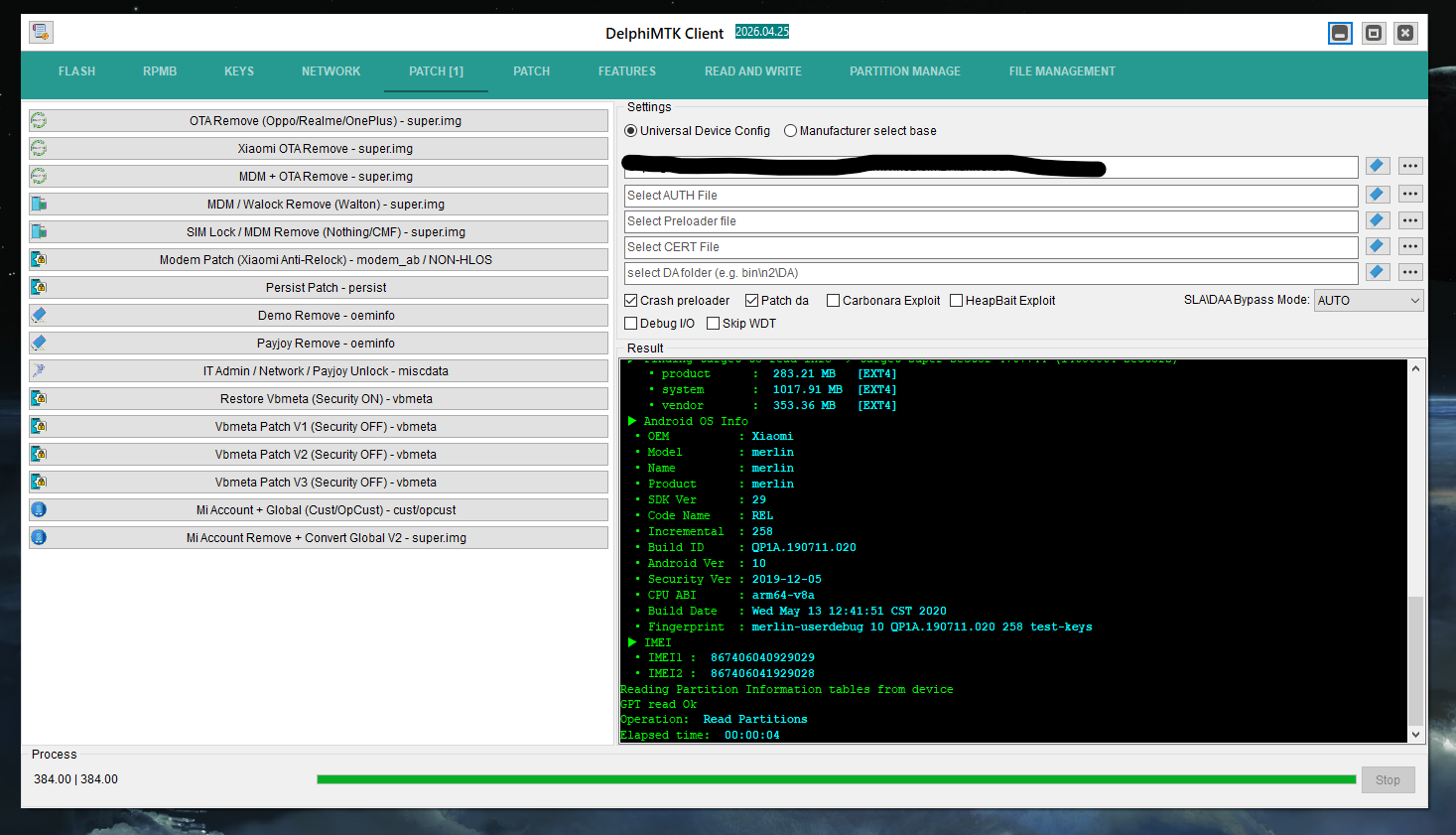
- OTA Remove for OPPO, Realme and OnePlus.
- Xiaomi OTA Remove.
- MDM + OTA Remove.
- MDM Remove.
- MDM / Walock Remove for Walton.
- SIM Lock / MDM Remove for Nothing / CMF.
- Xiaomi anti-relock Modem Patch.
- Persist Patch.
- Demo Remove.
- Restore Vbmeta for Security ON paths.
- Vbmeta Patch V1 / V2 / V3 for Security OFF paths.
- Fix no efuse state.
- Fix DM corrupted.
- Remove security plugin.
Security and Research-Oriented Paths
- SLA / DAA handling paths where supported.
- Kamakiri workflow paths where supported.
- HeapBait workflow paths where supported.
- Carbonara workflow paths where supported.
- New SLA key handling for selected Motorola, Xiaomi and AOT paths.
- Selected DA + exploit paths for supported Infinix chipsets.
- Vbmeta / dm-verity patch paths where supported.
- Brand and model-specific workflow examples where included by package scope.
UI notes (Delphi)
The Window layout, captions and control names follow SharpMTKClient. Delphi-specific choices:
- Default VCL
TPageControl/TTabSheet(no MaterialSkin tab control). - Flash tabs: Native, FashtoolLib API, OFP Flasher.
- Log control: TJvRichEdit.
- Partition / firmware grids: header check-all on
TCheckStringGrid.
Last Updates
2026.10.07
- updated imei repair of xiaomi (4G) (tested)
- updated imei repair for motorola (tested G05/G15/etc)
- updated Erofs/ext4fs/f2fs protocol
- added preloader erase/write/read in partition managment
- updated carbonara exploit
- added force exploit for some device that required read preloader (kamakiri)
- optimized and fixed a lot bugs
- Now delphimtkclient is more stable
2026.08.23
- Added OFP Flasher. Flash OPPO
.ofpdirectly, no extract. - Read Partitions writes scatter next to
GPT.pit. - Native scatter auto-check only when the image exists and
is_downloadis true. - Added Motorola and universal IMEI Repair.
- Fixed Get Partition stall after Android Info.
- Fixed hang at Finding target.
- all features and updates that exist in sharpmtkclient 2026.08.23
- added hundreds da file package from this page as gift : Mediatek DA(download agent) Pack updated
2026.04.25
- First public DelphiMTKClient product page.
- Delphi 12 VCL source package for LEGACY, XFLASH and XML protocol families.
What Developers Can Build With It
Because DelphiMTKClient is delivered as source code, it can be used as a foundation for different types of products and internal tools.
- A branded MTK service software product
- A private firmware flashing tool
- A research tool for MTK protocol analysis
- A device maintenance system for internal company use
- A model-specific repair or patch platform
- A Windows Delphi application with custom UI and licensing
- A learning base for developers studying MediaTek protocol flow
Technical Highlights
- Delphi VCL codebase for Windows development
- Protocol-oriented architecture shared with SharpMTKClient
- Separate logic for LEGACY, XFLASH and XML paths
- DA parser and stage upload handling
- Native partition and flash command paths
- MountCore-style file-system access modules
- OFP stream flash without unpacking the whole package
- Advanced paths for selected exploit / auth workflows
- Practical UI code that can be rebranded or redesigned
- Suitable base for commercial customization
Example Development Log Area
Hold boot key And Connect To PC (power off mode)
Waiting for mediatek port (Timeout 3 minute) : Ok
brom service detected
Handshake device : Ok
Reading device Info : Ok Ok
Mediatek XFlash Detected!
CPU Info : MT6768/MT6769 Helio G70/G80/G85
disabling WatchDog Timer WDT disabled Ok
Hardware Sub Code : 0x8A00
Hardware Code : 0x707
Hardware Version : 0xCA00
Software Version : 0x00
Is Secure boot : True
Serial Link authorization Protect : True
download agent authorization Protect : True
SWJTAG enabled: True
EPP_PARAM at 0x600 after EMMC_BOOT/SDMMC_BOOT: False
Root cert required: False
Mem read auth: True
Mem write auth: True
Cmd 0xC8 blocked: True
ME_ID: 0x1B1A97BD943F10FE97AC3D8E0F69B843
SOCID: 0xD597C6EF5EA660011AF11AED38CE555DE1461C227FF618C5C195E8432FF48DF7
Disabling Watchdog timer : Ok
Sending payload : Ok
Trying disable SLA\DAA Kamakiri : Ok
Manual Preloader selected !
Choosing the right da : Ok
Writing download agent : Ok
Jumping Download Agent : Ok
Sync signal : Ok
Setup environment : Ok
Setup param : Ok
Connection Status : brom mode
Sending emi : Ok
uploading stage 2: Ok
Bypassing DA SLA:
. rnid : 40DDDD360A86399B4A3546D87AD1AAD4
. DA SLA Authentication : Ok Ok
Adding DA Extensions: Ok
▶ Finding target to read info > target=super sector=4767744 (14680064 sectors)
• product : 922.58 MB [EXT4]
• system : 2.43 GB [EXT4]
• vendor : 683.98 MB [EXT4]
▶ Android OS Info
• OEM : Xiaomi
• Model : M2003J15SC
• Name : merlin_in
• Product : merlin
• Market Name : Redmi Note 9
• SDK Ver : 29
• Code Name : REL
• Incremental : V11.0.3.0.QJOINXM
• Build ID : QP1A.190711.020
• Android Ver : 10
• MIUI Ver : 9
• Security Ver : 2020-06-01
• Region : in
• Timezone : Asia/Shanghai
• CPU ABI : arm64-v8a
• SW Ver : Android10_11
• Build Date : Fri Jul 3 20:23:54 CST 2020
• Fingerprint : merlin-user 10 QP1A.190711.020 V11.0.3.0.QJOINXM release-keys
▶ IMEI
• IMEI1 : 867406040929029
• IMEI2 : 867406041929028
Screenshots and Videos
Use the placeholders below for screenshots and videos. Since this is a source code product, it is better to include both UI screenshots and code/module screenshots.
Videos
Video 1 – Source code overview:
Video 2 – Protocol flow demonstration:
Screenshots
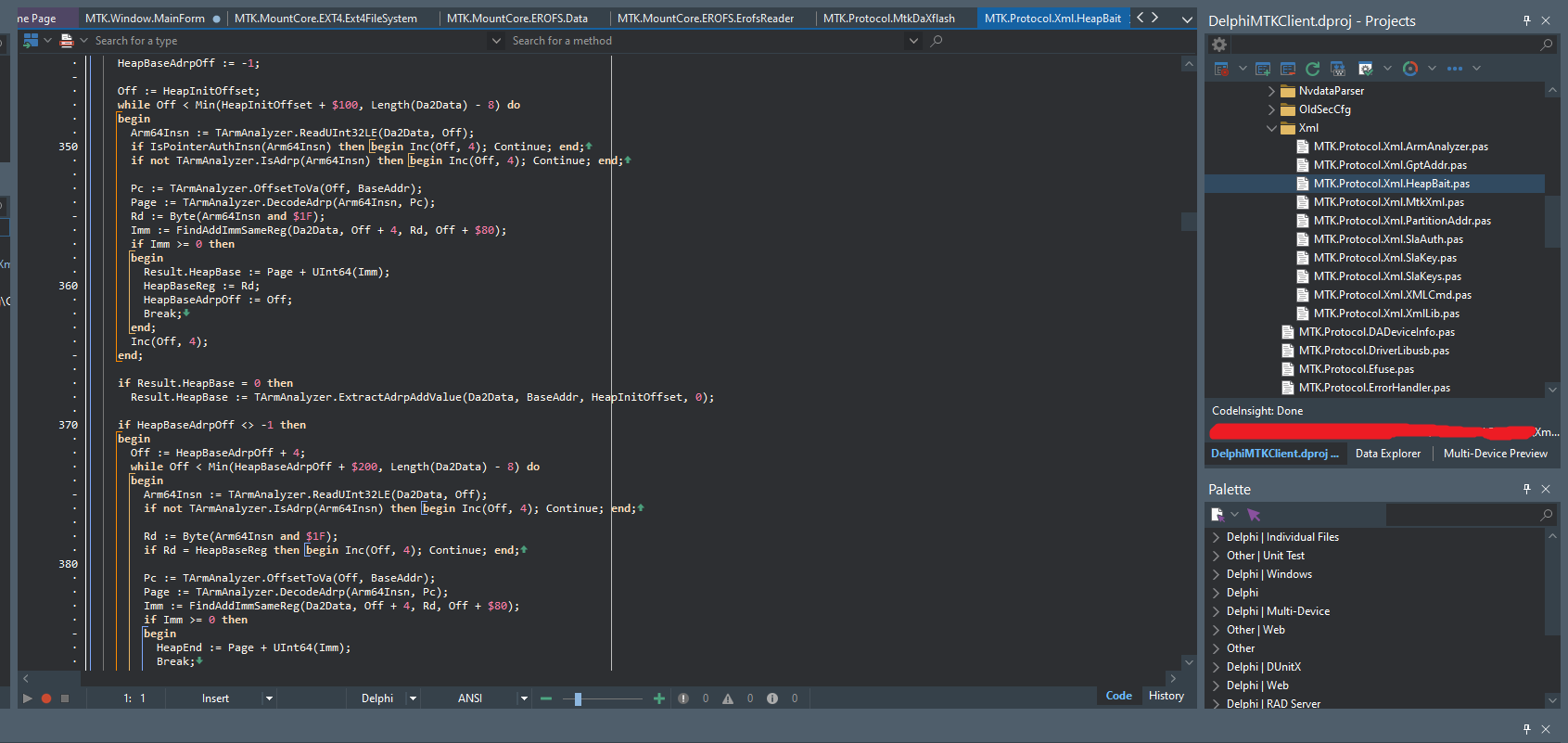
Project structure / source modules:
Main application interface:
Protocol code section:
Flash / partition module:
NV / IMEI module:
Patch / advanced module:
Important Notes for Buyers
- This is source code for developers, not a one-click consumer tool.
- MTK operations depend on chipset, DA support, boot mode and security state.
- Some workflows are model-specific and may require developer-side customization.
- Buyers should have Delphi development knowledge or a developer who can maintain the project.
- For commercial use, you can customize branding, UI, licensing and workflow logic.
Why Choose DelphiMTKClient Source Code?
Developing MTK protocol software from zero takes time. Developers need to handle low-level communication, device states, DA workflow, flash commands, partition data, storage differences and many protocol-specific edge cases. DelphiMTKClient reduces this starting cost by providing a ready Delphi codebase focused on MediaTek development.
From April 2026 to 2026.08.23 the live Class and Window paths were brought in line with SharpMTKClient. You get the same protocol families and service modules, in Delphi, with a VCL UI you can rebrand.
For developers and companies, the real value is flexibility. You can study the implementation, modify it, remove modules, add new workflows, connect your own backend or licensing system, redesign the UI and build your own product around the codebase.
If your goal is to own and develop a Delphi-based MTK solution instead of using a closed compiled tool, DelphiMTKClient is built for that purpose.
Licensing and Purchase
The full DelphiMTKClient source code is available through private licensing. Licensed buyers can use the source code inside their own private, internal or commercial software project according to the license agreement.
The source code must not be resold, exchanged, published for free, gifted, leaked, mirrored publicly or shared with third parties.
For pricing, licensing, support scope or technical questions, contact us on Telegram:
Disclaimer
DelphiMTKClient is intended for lawful development, research, maintenance and authorized service scenarios. Device operations may depend on chipset, boot mode, selected Download Agent, firmware package, storage type, security state and local regulations.
Use this project only for authorized devices and lawful service workflows.